
Eligibility to Become a Successful Agile Coach
To be eligible to become a successful agile coach you need a blend of hands-on Agile experience (teams or transformations), coaching and facilitation skills, formal training or certifications, business/domain understanding, and ongoing practice with feedback — all supported by a coaching mindset and measurable outcomes.
What does “eligibility to become a successful agile coach” actually mean?
It means having the right mix of experience, mindset, and credentials to reliably help teams and organisations adopt Agile — and to prove that your interventions create measurable improvements (faster delivery, better quality, stronger collaboration).
Being eligible isn’t a single certificate — it’s demonstrated capability: results + repeatable approach + trust.
Who should consider becoming an Agile Coach?
- Practitioners who’ve worked in Agile teams (Scrum, Kanban, XP) for 3+ years.
- Team leads, delivery managers, or senior developers ready to shift from doing to enabling.
- Change agents who enjoy facilitation, mentoring, and organisational design.
If you love teaching, unblocking teams, and improving ways of working, you’re already on the right path.
What core experience matters most?
Team experience: 2–5 years contributing in Agile teams (product delivery, devops, QA).
1. Transformation exposure: Participation in at least one cross-team or org-level Agile transformation.
2. Coaching or mentoring: Repeated practice coaching individuals and groups; not just managing.
3. Metrics & outcomes: Ability to show how your actions improved cycle time, quality, predictability, or engagement.
Example: A delivery lead who reduced sprint rollovers by 40% through backlog hygiene, paired work and team agreements demonstrates clear eligibility.
Do I need certifications to be eligible?
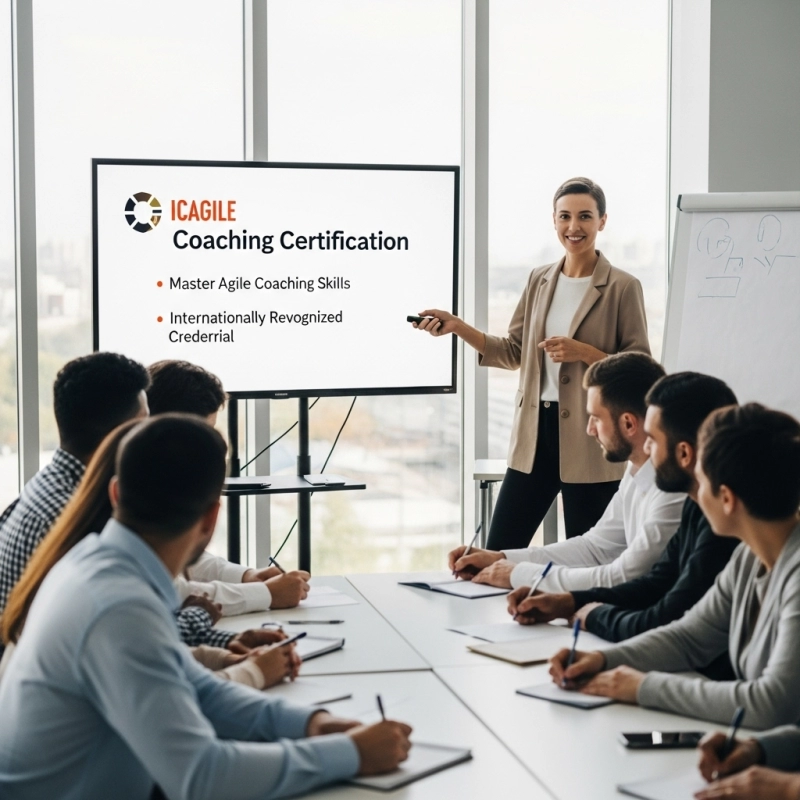
Helpful, not sufficient. Certifications (IC Agile, ICP-ACC, SAFe SPC) give a commonly understood baseline and help with credibility.
Pros:
- Fast credibility with HR/clients.
- Structured frameworks and vocabulary.
Cons:
- Certificates without experience won’t make you effective.
- Over-reliance on a single framework (e.g., only SAFe) can narrow your coaching toolkit.
At Coach2Reach we recommend combining a foundation certificate with documented coaching practice and case studies. See our courses and coaching programs for practical tracks.
What soft skills are required?
- Active listening and powerful questioning.
- Emotional intelligence and conflict navigation.
- Facilitation and workshop design.
- Stakeholder influence without formal authority.
These are the difference-makers that turn an Agile practitioner into a coach.
How important is business/domain knowledge?
Very. Coaches who understand the business context (finance, healthcare, retail, etc.) translate Agile improvements into outcomes leadership cares about: revenue, risk reduction, time-to-market.
Example: Coaching a fintech payments team requires different compliance and integration awareness than an ecommerce front-end team.
How do you prove eligibility to employers or clients?
- Maintain a portfolio: short case studies showing problem → intervention → metrics.
- Referenceable outcomes: managers or product owners who can vouch for improvements.
- Continuous learning: recent training, workshops run, community talks or blogs.
Hiring managers look for evidence, not just claims.
What are the common career pathways into Agile coaching?
1. Senior developer → Tech lead → Scrum Master → Agile Coach.
2. Delivery manager → Transformation consultant → Enterprise Agile coach.
3. External consultant with domain expertise plus Agile credentials.
Each path emphasizes different strengths — choose one that aligns with your natural skills (technical vs organisational).
How does an Agile Coach differ from Scrum Master, Product Owner, or Consultant?
Comparison at a glance
- Scrum Master: Team-level servant leader; focuses on ceremonies, impediments.
- Product Owner: Owns product outcomes, prioritisation, stakeholder alignment.
- Agile Coach: Works across teams and org layers; mentors, shapes culture, and drives sustainable change.
- Consultant: Often short-term, advisory; may not stay to coach adoption long-term.
A coach frequently operates at team, program, and executive levels — connecting delivery with strategy.
What are the top obstacles to eligibility — and how to overcome them?
- Obstacle: No cross-team experience.
Fix: Volunteer for program-level initiatives or internal guilds; coach other Scrum Masters.
- Obstacle: Weak stakeholder influence.
Fix: Train in facilitation and negotiation, collect quick wins with measurable impact.
- Obstacle: Too theoretical.
Fix: Run experiments, measure outcomes, iterate.
Eligibility is earned by deliberately filling gaps and demonstrating results.
Pros and Cons of formal certification vs experience-first approach
Formal certification
Pros: Faster credibility, structured learning.
Cons: Can be shallow without practice.
Experience-first
Pros: Demonstrable results, deeper understanding.
Cons: Slower perceived credibility to outsiders.
Best approach: combine both — learn the models, then apply them in practice.
