

Best Top 5 Agile Coaching Certifications
According to the 13th Annual State of Agile Report, when asked about the reasons for adopting Agile, the following response was received: It was less about an increase in productivity (51% compared to 55% last year), more about increasing the team’s morale (34% compared to last year’s 28%), less about reducing project risks (28% compared to 37% last year) and more about reducing the project costs (41% compared to 24% last year).
1. ICP-ACC (ICAgile- Agile Certified Coach):

This agile coach certification introduces participants to foundational team coaching skills and team development concepts for starting and growing teams while focusing on teams and organizations as human systems. A key part of this certification focuses on developing an understanding of the professional coaching skillset and the value of honing these skills to serve individuals on an agile team.
Agile Coaches or aspiring coaches with a passion for servant leadership and a desire to learn and practice facilitation, professional coaching, mentoring, and teaching in service of Agile teams. Other relevant roles include Scrum Masters, Iteration Managers, and Agile Project Managers. Although it is not a formal prerequisite, we have found that this agile coach certification is best pursued after Agile Team Facilitation (ICP-ATF).
2. ICP-ATF (ICAgile- Agile Team Facilitation):
The ICP-ATF is one of two knowledge-based certifications on the Agile Coaching Track. It focuses primarily on the mindset and role of an agile team facilitator, while also providing group facilitation tools and techniques for effectively designing meetings and workshops that both engage the entire audience and drive towards agreed-upon outcomes.
Through obtaining this agile coach certification, course participants will develop an appreciation for the art of facilitation as key to fostering collaboration and enabling self-organizing teams.
In addition, participants will build their facilitator toolkits and gain experience facilitating specific agile practices most relevant to their organizational context.
3. ICP-CAT (ICAgile- Coaching Agile Transformations):

As an advanced path, most courses in Enterprise Coaching for Agility involve a combination of classroom learning and ongoing group discussions around practical experience in the field.
Relevant roles include enterprise, program, and team-level Agile Coaches, Agile Team Facilitators, or anyone aspiring to these roles. Also, anyone with a strong background in change management and/or organizational design and a curiosity about agile approaches at the enterprise level will benefit from this certification.
4. ICP-ENT (ICAgile- Enterprise Agile Coaching):
The Learning Outcomes include topics such as systems and complexity theory, measuring business performance from an agile perspective, agile frameworks for enterprise scaling, awareness of organizational design and structure, understanding leadership development, and engaging leadership in conversations about organizational culture.
Relevant roles include enterprise, program, and team-level Agile Coaches, Agile Team Facilitators, or anyone aspiring to these roles. Also, anyone with a strong background in change management and/or organizational design and a curiosity about agile approaches at the enterprise level will benefit from this certification.
5. Scrum Alliance Certified Team Coach® (CTC) This is a journey
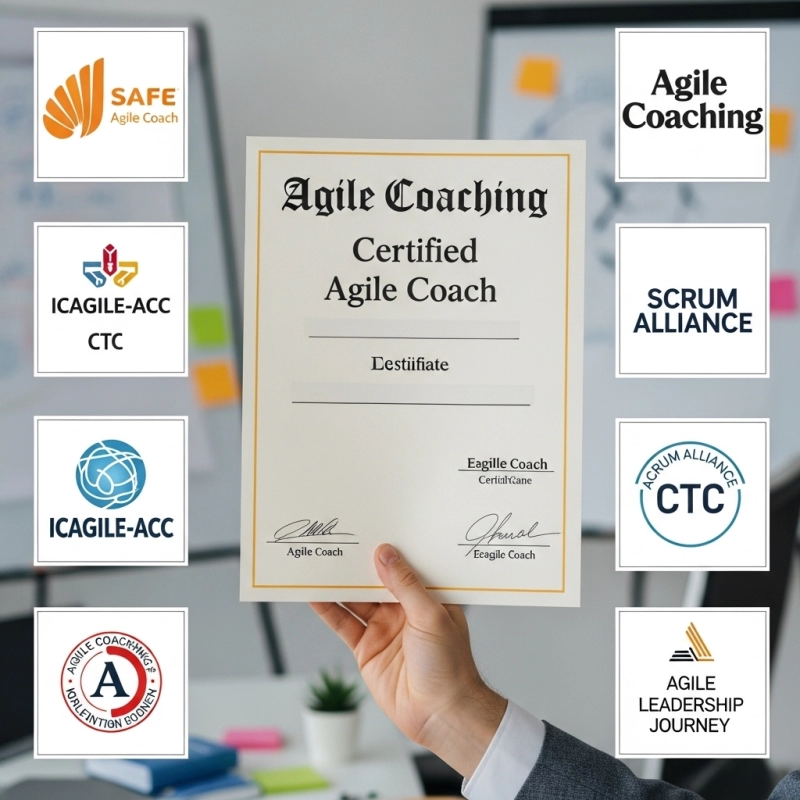
If you have demonstrated experience, knowledge, professional collaboration, and skills, it’s time to explore becoming a CTC, a certification that offers a recognized credential to qualified coaches who can effectively impact department, project, and program agility.
